
Available 24/7 — Nurse-led care you can depend on, day or night | Covering Lincolnshire, Nottinghamshire & National Live-In Care
What Is Domiciliary Care? A Complete Guide for Families in Lincolnshire & Nottinghamshire
Everything families need to know about domiciliary care in Lincolnshire & Nottinghamshire. Nurse-led guide covering costs, funding, and what to look for in a provider.
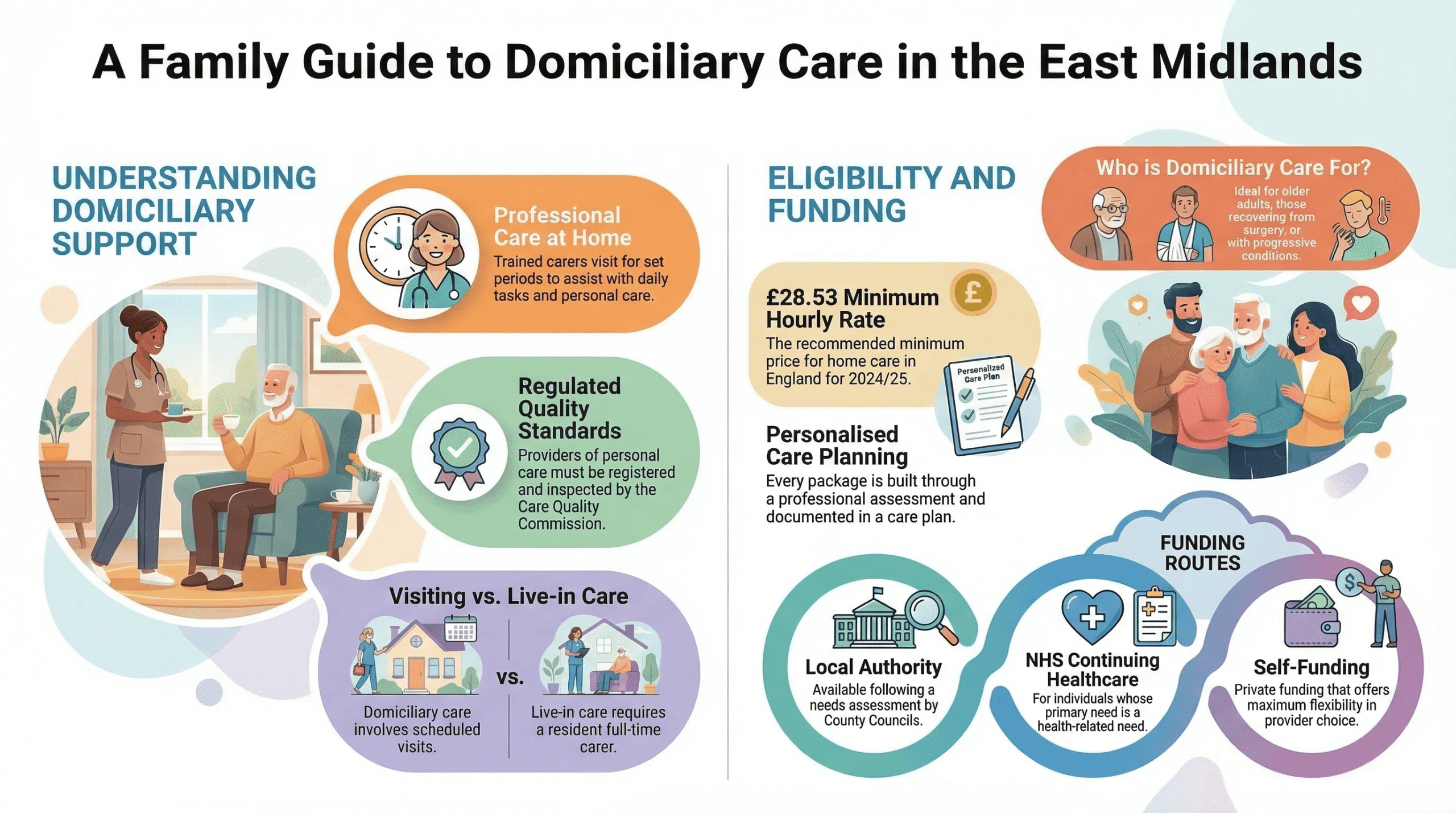
Domiciliary care is professional support delivered inside a person’s own home. A trained carer visits regularly to assist with daily tasks, personal care, medication, and companionship — enabling the individual to remain independent at home rather than moving into a residential facility. It is the most common form of home-based support for older adults and individuals with disabilities across the United Kingdom.
Domiciliary care — also called home care or domiciliary support — is one of the most widely used care services in the UK. According to the United Kingdom Home Care Association (UKHCA), approximately 900,000 people in England receive some form of home care at any given time. Yet many families who could benefit from it have never fully understood what it involves, who it is for, or how to access it.
This guide answers every question families in Lincolnshire and Nottinghamshire ask us about domiciliary care — clearly, honestly, and without jargon.
What Does Domiciliary Care Actually Include?
Domiciliary care is not a single, fixed service. It is a flexible, personalised package of support built around what the individual actually needs. Support can range from one visit per day to several visits per day, depending on the level of need.
Typical activities covered in a domiciliary care package include:
- Personal care: assistance with washing, dressing, bathing, and grooming
- Medication support: reminding or assisting with medication at the correct times
- Meal preparation: planning, cooking, and serving nutritious meals
- Mobility assistance: helping the individual move safely around the home
- Companionship: regular social interaction to reduce isolation and support mental wellbeing
- Light domestic tasks: housekeeping, laundry, and keeping the home safe and clean
- Appointment escort: accompanying the individual to GP appointments, hospital visits, or social activities
- Shopping: collecting groceries and essentials on the individual’s behalf
Each package is built through an assessment process and documented in a personalised care plan — a written record of exactly what support will be provided, how, and when.
Who Is Domiciliary Care For?
Domiciliary care is appropriate for a wide range of individuals and situations. It is not exclusively for older adults — though they represent a significant proportion of home care recipients.
Domiciliary care is commonly used by:
- Older adults who need help with daily living tasks but wish to remain in their own home
- Individuals with learning disabilities requiring regular structured support
- People recovering from a hospital admission, surgery, or acute illness
- Individuals with progressive conditions such as dementia, Parkinson’s disease, or multiple sclerosis
- Adults with physical disabilities who need practical assistance throughout the day
- Individuals with mental health conditions who benefit from structured daily support
According to the NHS Long Term Plan (2019, updated 2024), enabling people to receive care at home rather than in institutional settings is a central objective of UK health and social care policy — making home care provision increasingly important across the country.
How Is Domiciliary Care Different from Live-In Care?
The key distinction is the model of delivery.
Domiciliary care involves a carer visiting the individual’s home for a defined period — typically 30 minutes to several hours, once or multiple times per day. The carer does not live in the home.
Live-in care involves a carer residing in the individual’s home full time, providing round-the-clock support and supervision. This model is more intensive and suited to individuals with more complex or constant care needs.
For many families, domiciliary care is the starting point — providing essential support while preserving the individual’s independence and routine. As needs evolve, the package can be adjusted or transitioned to a live-in arrangement.
Is Domiciliary Care Regulated in the UK?
The provision of regulated domiciliary care in England is overseen by the Care Quality Commission (CQC) — the independent regulator of health and social care services. Providers who deliver personal care as defined under the Health and Social Care Act 2008 are required to register with the CQC and are subject to inspection.
Families considering a domiciliary care provider should always check the provider’s CQC registration status and, where available, review their most recent inspection report at cqc.org.uk.
Not all home support activities require CQC registration. Services such as companionship, shopping, escorting, meal preparation, and light domestic tasks are considered unregulated activities and can be delivered by providers without CQC registration. However, clinical oversight, professionalism, and a genuine care ethos should still be expected regardless.
How Much Does Domiciliary Care Cost in the UK?
The cost of domiciliary care varies depending on location, the level of need, and the provider.
According to the Homecare Association’s Minimum Price for Homecare 2024/25, the recommended minimum hourly rate for home care in England is £28.53 per hour — though many specialist or nurse-led providers may charge more to reflect the quality and clinical expertise of the service.
Funding options for domiciliary care include:
- Local authority funding: Available following a needs assessment by adult social care. Both Lincolnshire County Council and Nottinghamshire County Council offer free care needs assessments for eligible individuals.
- NHS Continuing Healthcare (CHC): For individuals whose primary need is a health need, NHS CHC can fund care in full. Eligibility is determined by the NHS using the National Framework for CHC.
- Self-funding: Many families fund care privately, which gives maximum flexibility in choosing a provider.
- Attendance Allowance / PIP: These DWP benefits can contribute towards care costs for eligible individuals.
What to Look for in a Domiciliary Care Provider
Choosing the right provider is as important as choosing the right type of care. The following qualities should be non-negotiable:
- Clinical oversight: Is care delivered under the guidance of a qualified healthcare professional?
- Person-centred approach: Is the care plan genuinely built around the individual, or is it a generic template?
- Transparency: Are costs, processes, and expectations explained clearly and honestly?
- Accessibility: Can you reach the provider outside of office hours? Are they genuinely available 24/7?
- Accountability: Is there a named, accessible person responsible for the quality of care?
Domiciliary Care in Lincolnshire and Nottinghamshire
Reliable Support Group provides nurse-led domiciliary care across Lincolnshire and Nottinghamshire. Every care package begins with a listening consultation and a nurse-led assessment — ensuring the support we provide truly reflects the individual’s needs, preferences, and lifestyle.
We are available 24 hours a day, seven days a week. There is no obligation in contacting us — only a genuine conversation about how we can help.
Frequently Asked Questions — Domiciliary Care
Can domiciliary care be arranged at short notice?
Yes. Good providers should be able to respond quickly to urgent care needs — for example, following a hospital discharge or sudden change in a family member’s condition.
How many visits per day can a domiciliary carer provide?
This depends on the individual’s needs. Packages typically range from one to four visits per day. Some individuals receive a combination of shorter daily visits and longer support sessions.
What is the difference between a carer and a care worker?
In UK home care, these terms are used interchangeably. A carer (or care worker) is a trained professional who provides personal and practical support. In nurse-led organisations, care delivery is additionally overseen by a qualified nurse.
Does domiciliary care replace family support?
No — domiciliary care works alongside family involvement. A good care provider will communicate openly with family members and ensure that care complements, rather than replaces, existing family relationships.
What happens if I am not happy with my care?
Every reputable provider should have a clear complaints and concerns process. In addition, the CQC provides a channel through which concerns about regulated care providers can be reported.