
Available 24/7 — Nurse-led care you can depend on, day or night | Covering Lincolnshire, Nottinghamshire & National Live-In Care
Live-In Care vs Care Homes: Which Is the Right Choice for Your Family?
An honest, detailed comparison of live-in care and residential care homes — covering cost, quality of life, continuity of care, and which option suits different needs.
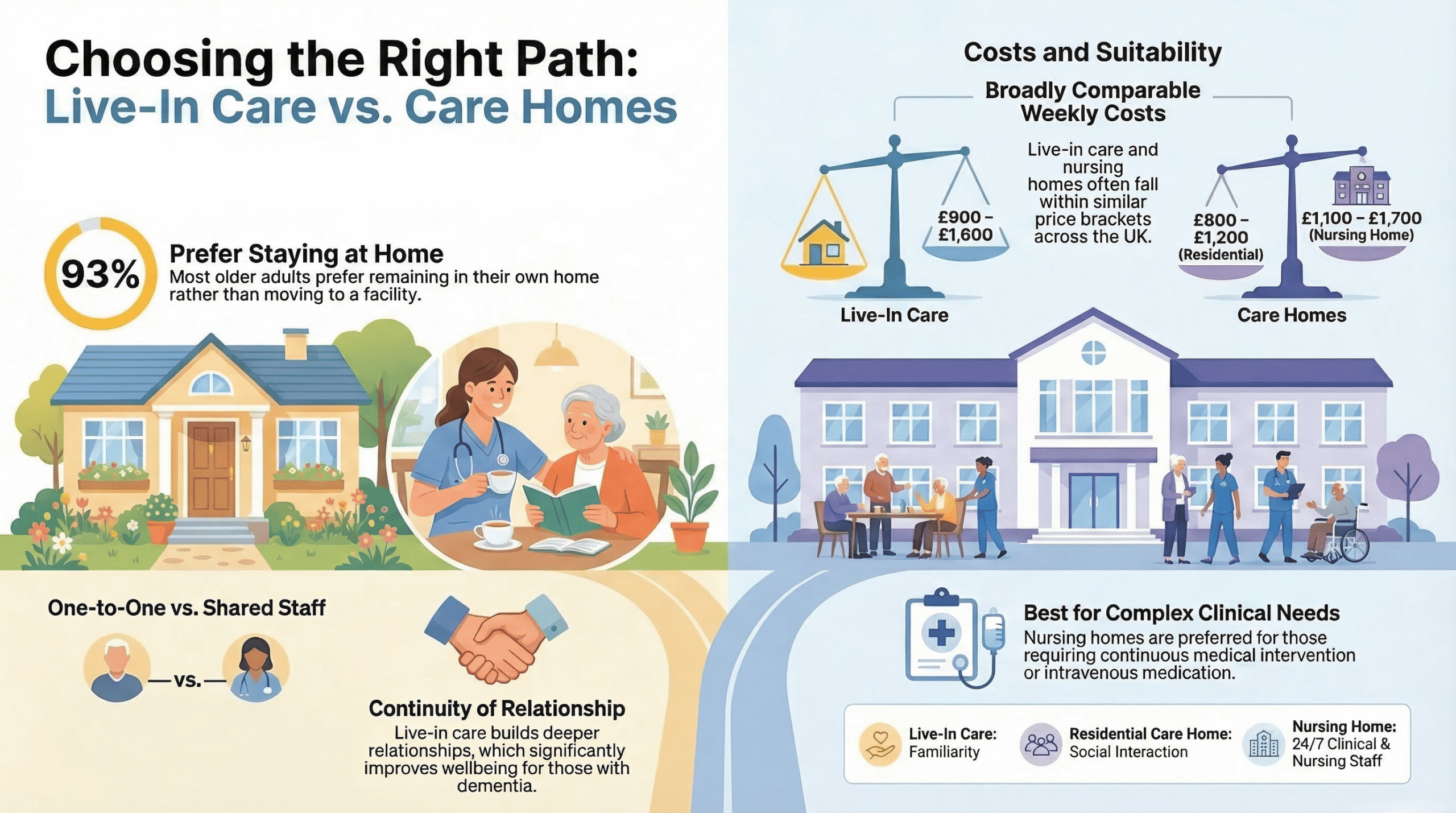
Live-in care keeps the individual in their own home with a dedicated, full-time carer providing one-to-one support. A care home places the individual in a residential facility with shared staff. Live-in care typically preserves more independence, routine, and personal continuity — while care homes may be more appropriate for individuals who require a higher level of clinical or nursing support around the clock.
When a family reaches the point where a loved one needs full-time support, two options tend to dominate the conversation: live-in care at home, or a move to a residential care home.
Both are legitimate choices. Neither is universally right. The correct answer depends on the individual’s needs, preferences, and personal circumstances — and on an honest appraisal of what each option actually involves.
This guide sets out the genuine differences between live-in care and residential care homes, covering cost, quality of life, continuity of care, and the key questions families should ask before making a decision.
What Is Live-In Care?
Live-in care is a model of care in which a trained carer moves into the individual’s home and provides support around the clock. The individual continues to live in their own home — their own bedroom, their own routine, their familiar surroundings — while receiving dedicated, one-to-one professional support.
The carer works on a rota basis, typically spending two to four weeks in the home before being replaced by a second carer, ensuring continuity without disruption to the individual’s routine.
Live-in care is available for a broad range of needs — from older adults requiring daily assistance and companionship, to individuals with complex health conditions, learning disabilities, or dementia who need consistent, specialist support.
What Is a Residential Care Home?
A care home is a registered residential facility where individuals live and receive personal and, in some cases, nursing care from a team of staff on site.
There are two main types. Residential care homes provide personal care and social support but do not typically have nursing staff on site around the clock. Nursing homes provide a higher level of clinical care, staffed by registered nurses, for individuals with significant medical needs.
According to the Care Quality Commission’s State of Care Report 2024/25, approximately 410,000 people in England live in care homes at any given time.
Comparing Live-In Care and Care Homes Across Key Factors
Familiarity and Environment
Live-in care allows the individual to remain in the home they know — surrounded by their possessions, their memories, and their neighbourhood. Research from the University of Kent (2023) found that remaining at home is the preferred option of 93% of older adults when asked about their future care preferences.
A care home requires adapting to a new environment, new routines, and new faces — a transition that can be particularly challenging for individuals living with dementia or high levels of anxiety.
Staff-to-Resident Ratio
In live-in care, the individual receives dedicated one-to-one support from a single carer at all times. There is no competition for attention, no delays in receiving help, and no assumption that a member of staff will be free when needed.
In a residential care home, staff-to-resident ratios vary. UK minimum standards do not prescribe a specific ratio, and in practice, a single care worker may be responsible for several residents simultaneously — particularly during overnight hours.
Continuity of Care
With live-in care, the individual builds a genuine relationship with their carer — someone who knows their routines, preferences, and history. This continuity has been shown to have a significant positive effect on wellbeing, particularly for individuals with dementia.
In a care home environment, continuity can be more difficult to maintain due to staff rotas, shift patterns, and the high turnover rates that characterise parts of the UK care sector. The Care Quality Commission notes that staff continuity is one of the most frequently raised concerns in family feedback about residential care.
Cost
The cost of live-in care in the UK typically ranges from £900 to £1,600 per week depending on the level of need and the provider. This compares with the average cost of a residential care home place — approximately £800 to £1,200 per week according to Laing Buisson’s Care Home Market Report 2025 — and a nursing home place at £1,100 to £1,700 per week.
Costs are therefore broadly comparable, with live-in care often representing better value when the one-to-one nature of the support is taken into account.
Suitability for Complex Needs
Live-in care, particularly when nurse-led, is suitable for a wide range of complex needs — including learning disabilities, acquired brain injury, dementia, Parkinson’s disease, and complex physical health conditions.
A nursing home may be the more appropriate option for individuals requiring a high level of continuous medical intervention — for example, those who are clinically unstable and require frequent nursing assessment or intravenous medication.
Questions to Ask Before Deciding
Before committing to either option, families should seek clear answers to the following:
- What is the staff-to-resident or staff-to-client ratio, and how is this managed overnight?
- How is care continuity maintained when staff change?
- What happens if the individual’s needs increase significantly — is the care flexible enough to adapt?
- What is the total weekly cost, and are there any additional charges not included in the headline rate?
- How will family members be kept informed and involved?
When Live-In Care May Be the Better Choice
Live-in care is likely to be the more appropriate option when the individual values their independence, has a strong attachment to their home, would find a change of environment distressing, has a progressive condition that benefits from consistent and familiar support, or when their needs — while significant — do not require 24-hour nursing-level clinical intervention.
When a Care Home May Be More Appropriate
A residential or nursing care home may be more appropriate when the individual requires a level of clinical care that cannot be safely provided at home even with live-in support, when social interaction with peers is a significant factor in wellbeing, or when the individual themselves expresses a preference for residential care.
How Reliable Support Group Can Help
Our live-in care service is available nationally across the United Kingdom. Every live-in care arrangement begins with a thorough nurse-led assessment, a bespoke care plan, and a careful matching process to ensure the individual and their carer are the right fit.
We are available to discuss your situation at any time — with no obligation and no pressure.
Frequently Asked Questions — Live-In Care vs Care Homes
Can live-in care support someone with dementia?
Yes. Live-in care is widely considered one of the most effective models of care for individuals living with dementia, as it preserves familiarity, routine, and one-to-one relationships — all of which are critical to managing dementia-related anxiety and disorientation.
Is live-in care available at short notice?
Good providers should be able to respond to urgent requests — for example, following a hospital discharge. Contact us to discuss your specific timeline.
What happens if the live-in carer is unwell or unavailable?
Reputable live-in care providers maintain a pool of qualified carers to ensure continuity. A replacement carer should be arranged with minimal disruption to the individual’s routine.
Does live-in care qualify for NHS Continuing Healthcare funding?
Yes — individuals who meet the eligibility criteria for NHS Continuing Healthcare can use this funding for live-in care as an alternative to a nursing home placement.